Here's a question nobody wants to answer honestly.
What are you standing on?
Not what you believe. Not what you prefer. What is the foundation underneath your method of knowing things — and can you prove it's solid without using the method itself to check?
Because here's the thing that stopped me: neither side can.
The atheist says: "I only believe what science can prove." And that sounds rock-solid until you ask the obvious follow-up.
Can science prove that science is the only valid way to know things?
No. It can't. That claim isn't a scientific finding. It's a philosophical commitment dressed in a lab coat. It's an axiom — an assumption you accept before the first experiment, not a conclusion that came out of one.
And it's not the only one. Before science can take its first measurement, it has to smuggle in ten assumptions it cannot test with its own tools.
That the external world exists. That it's orderly and knowable. That logic works. That your senses are gathering truth, not just keeping you alive long enough to reproduce. That math — this abstract thing humans do with symbols on paper — actually maps onto physical reality. That the laws of nature will be the same tomorrow as they were today. That truth exists. That honesty matters. That numbers are real. That simpler explanations are better.
Ten assumptions. Zero of them provable by experiment. Every single one required before you can design the experiment.
A philosopher of science named Hugh Gauch said it plainly: these foundations are "legitimated by appeal to common sense and sincerity." Not by evidence. Not by data. By common sense and sincerity. Those are the words. That's the floor science is standing on. Sincerity.
I want you to sit with that for a second. The system that demands proof for everything is itself standing on a foundation it accepted without proof. Not because the foundation is wrong — I think it's right. But because the system cannot validate its own starting point using its own method.
That's not an attack on science. Science is extraordinary. It split the atom. It mapped the genome. It sent a robot to Mars and landed it on a dime. But science is a method — and every method rests on assumptions that precede it. The wrench doesn't explain the workshop.
Now run it the other direction.
The Christian says: "The Bible is the Word of God." And that sounds like a conversation-ender until you ask the same follow-up.
How do you know the Bible is the Word of God? Because the Bible says so?
Yes. That's exactly the structure. If the Bible is the highest authority, then appealing to something above it — human reason, archaeological evidence, scientific consensus — would mean that thing is actually the higher authority. The system self-attests because if it didn't, it would undermine its own claim.
The theologian says God "swore by himself because there was no one greater by whom to swear." The sun doesn't need a flashlight to prove it's shining. You see the flashlight because the sun is already doing the work.
That's not a proof. That's a structural commitment. An axiom. The same kind of move.
Stay with me here. This is where it gets precise.
Both systems are circular. Not accidentally. Structurally. The circularity isn't a bug — it's a feature of any system that claims to be foundational. If your foundation could be validated by something outside itself, then that outside thing would be the real foundation. So every ultimate starting point — whether it's the Uniformity of Nature or the Character of God — has to validate itself. There's nowhere else to stand.
Science uses induction to prove that induction works. The scientific method has been successful in the past, therefore it will be reliable in the future — which is itself an inductive argument. David Hume pointed this out three centuries ago and nobody's solved it since.
Theology uses Scripture to prove that Scripture is authoritative. The Bible attests to its own divine origin, and the internal witness of the Holy Spirit confirms it to the believer. John Calvin called this the "self-authentication" of the Word.
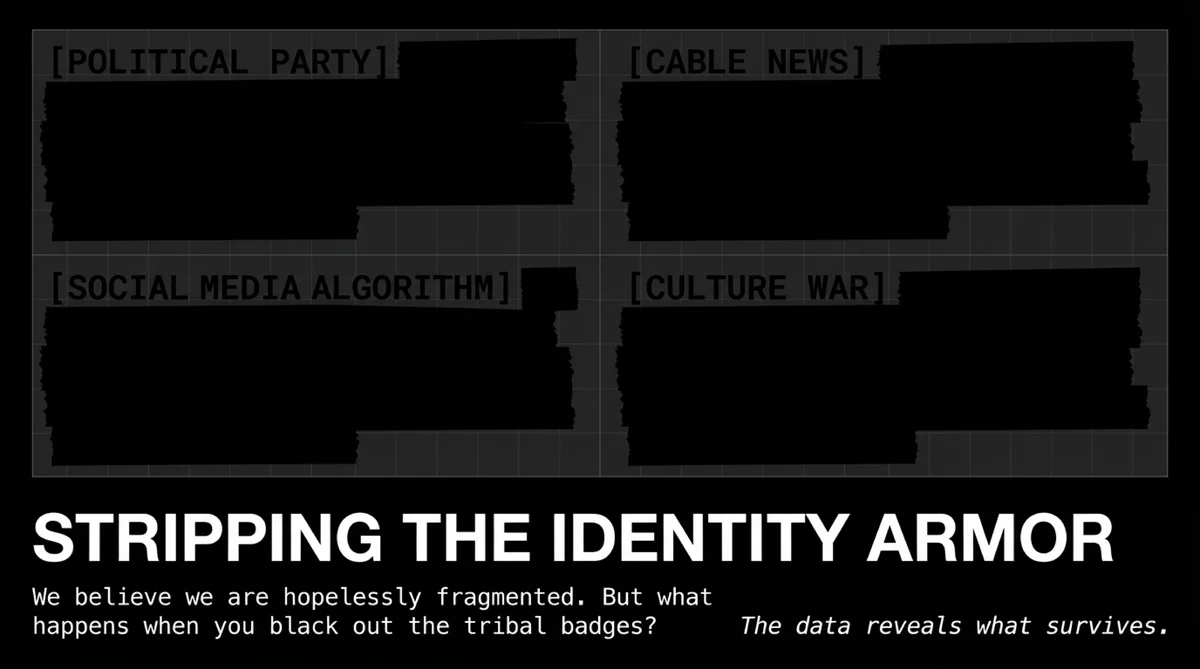
Two circles. Two axioms. Two acts of faith — because that's what accepting an unprovable starting point is, whether you call it faith or not.
The atheist flinches at that word. But the shoe fits. You believe the universe is orderly because it has been so far — and you trust that pattern will continue. You can't prove it will. You believe it. You have faith in the uniformity of nature. You just never use that word for it.
I want to show you something. Here's a table that maps these two systems side by side. Not to declare a winner — to show you the architecture.
The foundational axiom of science: the natural world is causally closed. Every physical effect has a sufficient physical cause, full stop. This is what allows the method to work. If God could interrupt the causal chain with a miracle on Tuesday, your Tuesday experiment means nothing. So science rules out the supernatural before it starts — not because it's been disproven, but because allowing it would break the method.
The foundational axiom of theology: God is self-existent and has revealed himself. He depends on nothing external. Knowledge is possible because the mind that designed reality also designed the minds that perceive it. There's a pre-established harmony between the knower and the known — and that harmony is the reason science works at all.
Both of those are axioms. Neither can be tested by the other's method without begging the question. And both are load-bearing — pull either one and the entire system it supports collapses.
Here's what this means.
The next time someone tells you "science has disproven God," you're looking at a category error. Science never tested God. Science tested natural causes and found them remarkably good at explaining natural effects. That's what it was built to do. But claiming that natural causes are all that exist is not a finding — it's the axiom you assumed before the findings started.
And the next time someone tells you "just have faith," you're looking at the same category error running in the other direction. Faith isn't the absence of evidence — it's the acceptance of a starting point that can't be validated from outside itself. And so is science. The question isn't faith versus evidence. The question is: which axiom, once granted, explains more of what we actually observe?
That's the honest framing. Two circles. Two starting points. Both accepted without external proof. Both productive. Both limited by what they assumed at the beginning.
Now we can actually talk.
Because once you see that neither side gets the high ground — once you realize the atheist is standing on faith and the Christian is making a structural claim — the conversation changes. It stops being "my evidence versus your fairy tale" and starts being "which foundational commitment accounts for more of reality."
That's the playing field. Level. Honest. No free shots.
Everything that follows in this series happens on this field. We're going to run the evidence in both directions — Bible predicting science and science pointing back at something it can't name. We're going to ask why math works and watch the answer point somewhere no one expected. We're going to walk through a graveyard of thirteen scientific paradigms and ask what that pattern means. We're going to find a judgment layer running in every human being that nobody installed. We're going to prove that evil can't come first. And we're going to score the whole thing — honestly, with the weakness named and the kill conditions posted.
But none of that works if you think one side already won before the argument started.
Neither side won. The field is level. And now we run.